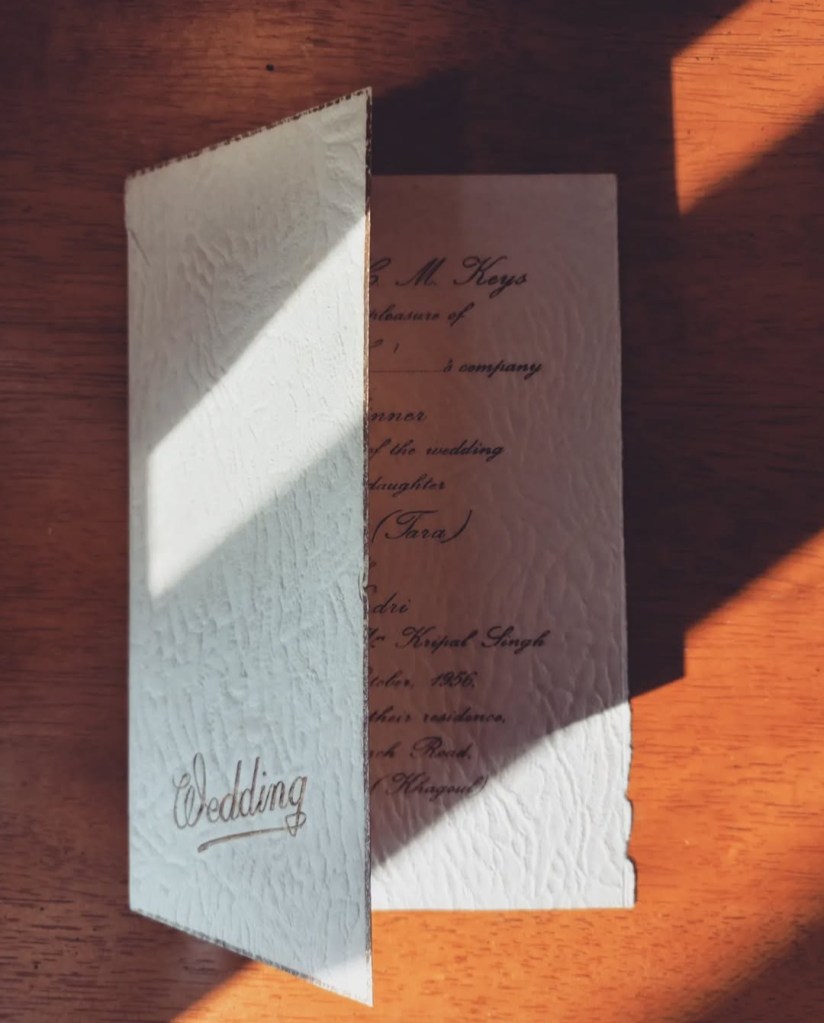
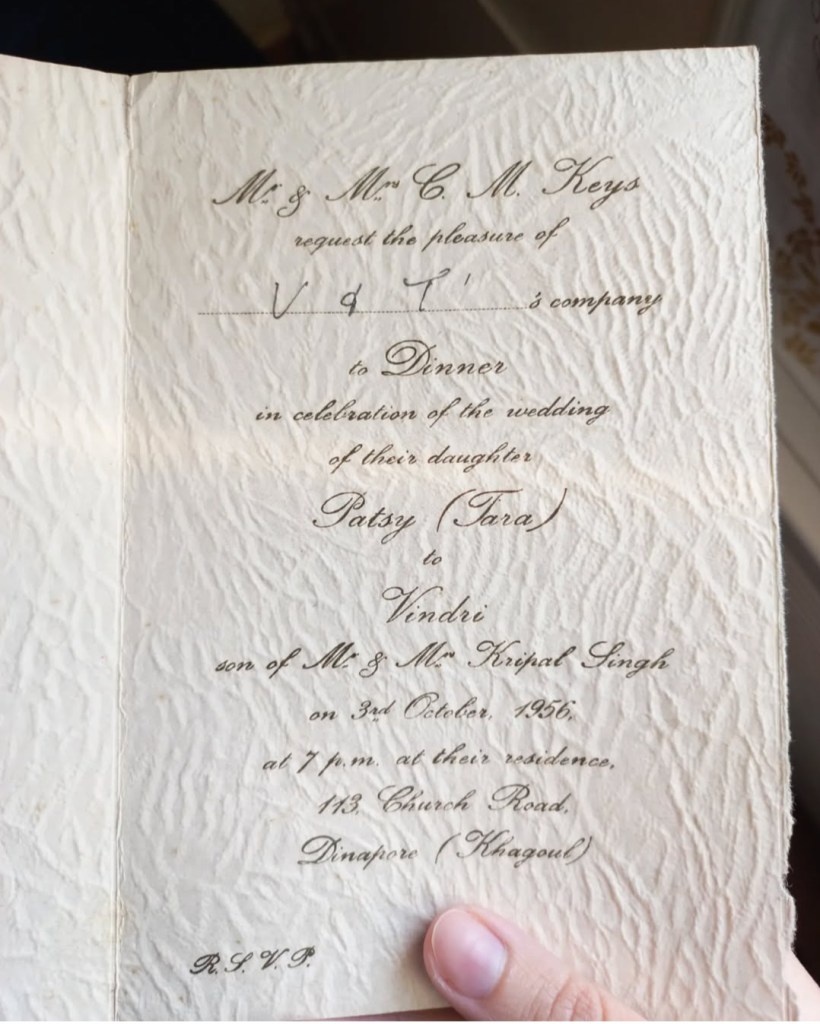
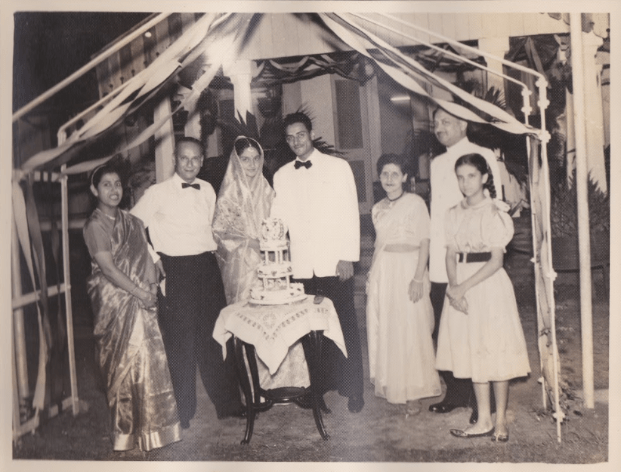
I invite you to two weddings in India in the 1950s. My grandparents had a busy day, with both a Hindu ceremony and a church wedding, followed by a dinner at 7pm. My grandfather had only three days’ leave to travel to Khagoul, get married, travel to see his brother who couldn’t make it to the wedding on account of illness, and travel back to the steamer where he worked.
My grand-uncle’s celebrations also started in the morning, continuing to the next day with the baraat (wedding procession where the groom comes to the bride’s home) arriving at 5.30pm. No crazy late nights for these folks! I’m told that my dadi would often make her famous kulfi-shaped pinnis for such occasions – though hopefully she had some help!
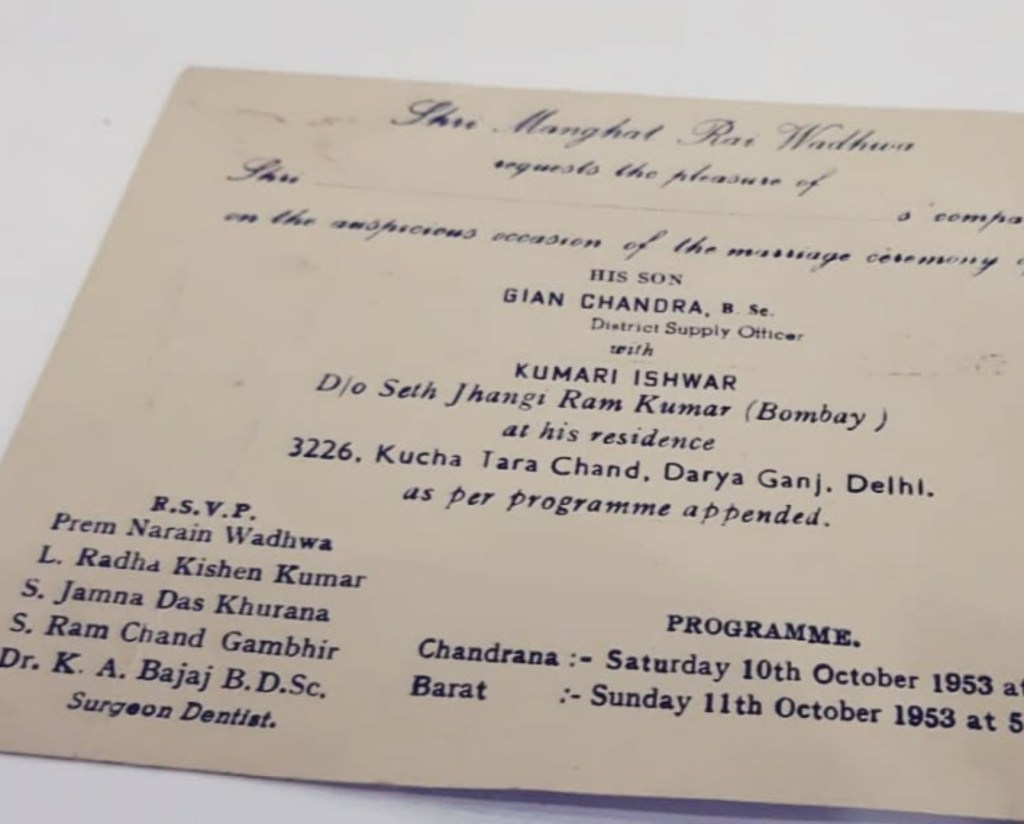
Both invitations begin with the name(s) of my great-grandparents requesting the pleasure of the recipient’s company, pleasurable or not as it may be. Perhaps common for the time, both events were also slated to take place at their respective residences, with a complete address provided; a genealogical gold mine!
Since I never got to meet my dada-dadi, and have very few of their actual possessions, I think this is one of the only places where I’ve seen one of their names in writing. It’s extra fun that my dada is the only person apart from the groom whose qualifications and profession were also included on the card.
Marriages are one of the three vital records, also called BMD (birth, marriage, death) records that genealogists try to hunt down as a starting point. A wedding invitation – though it doesn’t guarantee that the marriage actually took place – can nonetheless provide a wealth of information, especially for families that don’t have formal documentation and records, as is often the case in India.
Here’s what we can glean from the above examples:
- Names of immediate family (parents, grandparents)
- Dates of the planned wedding and other celebratory events (marriages in India typically span a few days)
- Nicknames! (my grandparents’ first names are actually Patience and Virendrapal, but who’s going to say all that?)
- Addresses! Both invites have the address of my great-grandparents, as well as the hometown of the bride in one case; but even if it’s not a home address, there can be clues of a region, parish etc. where they lived
- Indian wedding invitations often carry the names of additional family and close friends (which is why my dada features in the second one; I still haven’t figured out some of those other names)
- Profession and educational qualifications; this one is rare, I think (or maybe not during that time?)
Not quite the same as an e-vite.
 Kriti Bajaj
Leave a comment